Official CADAC Mauritius Website

Gas vs Charcoal BBQ in Mauritius: Which Is Better for You?

Choosing the right barbecue for the way you cook
Reading time: 10–12 minutes
Quick answer
A gas BBQ is usually the easier choice for frequent meals and straightforward heat control. A charcoal BBQ suits cooks who enjoy managing a fire and want the experience of cooking over embers. For a home in Mauritius, compare the complete setup, fuel supply, outdoor space and cleaning routine before choosing.
You want to cook outside more often, but you are caught between the convenience of gas and the appeal of charcoal. Will the food taste different? Is one cheaper to run? And will the barbecue you enjoy on a Sunday still appeal when you are making dinner after work?
This gas vs charcoal BBQ comparison focuses on that decision.
📖 For the broader questions of size, cooking space and features, start with our guide to choosing the right BBQ for your home in Mauritius.
At a glance
Quick comparison
| What matters to you | Gas BBQ | Charcoal BBQ |
|---|---|---|
| Getting started | Light the burners, then preheat as instructed | Light the fuel, establish the fire and prepare the cooking zones |
| Adjusting the heat | Turn the controls; response depends on the grill and surface | Manage airflow, fuel placement and the food’s position |
| Flavour | Browning and grilled flavour; added smoke is possible on suitable models | Cooking over embers, with smoke character that varies by fuel and technique |
| Cooking flexibility | Direct and indirect cooking where the burner layout allows | Direct and indirect cooking with a suitable coal arrangement |
| After cooking | Clean food residue and grease; maintain gas components | Clean food residue and grease, plus remove completely cold ash |
| Budget | Include the compatible gas supply and any separately sold connections | Include charcoal, suitable lighting equipment and replacement fuel |
| Best fit | Regular meals and cooks who value convenient heat adjustment | Cooks who enjoy tending a fire and allow time for preparation and cooling |
These are practical trade-offs, not ratings. The design of the barbecue still matters: two grills using the same fuel can offer different cooking surfaces, heat control and cleaning access.
Does charcoal really taste better than gas?
Charcoal can produce a more pronounced smoke character, especially during longer cooks. Whether that tastes better is personal. For quickly grilled food, the difference may be less noticeable than you expect.
It helps to separate browning from smoke flavour. Browning creates the crust on a steak or the roasted notes on vegetables. Both gas and charcoal can do this. Smoke adds another layer, influenced by the fuel, the cooking time and any suitable smoking wood used.
Gas grilling is therefore not flavourless. On many gas grills, juices falling onto hot components beneath the food also contribute to its grilled character. A solid plancha cooks differently from an open grate, even when both use gas.
For fish, prawns or vegetables, ask whether you actually want a strong smoke flavour. For slow-cooked meat, that character may be central to the meal. Neither preference needs defending; it simply changes what you should buy.
Choose charcoal if cooking over embers is something you want to learn and enjoy. Choose gas if you want grilled meals with less fire management. Do not buy charcoal solely because you assume a gas BBQ cannot produce satisfying food.
Which is quicker and easier to use?
Gas for a shorter preparation routine
Gas removes the need to light and establish a bed of coals. Once the barbecue is connected and checked according to its instructions, you can ignite the burners and begin the appropriate preheat. This is useful for smaller meals where a long preparation routine would discourage you from cooking outside.
However, quick ignition does not mean every gas BBQ is ready to cook immediately. Follow the instructions for the model and cooking surface.
For example, CADAC’s UK guidance for its ceramic cooking surfaces describes a short preheat of around two to three minutes at medium heat. That guidance should not be applied automatically to every patio grill or accessory. It also warns against overheating ceramic surfaces.
Charcoal when preparation is part of the enjoyment
With charcoal, you need to establish a usable fire before cooking. Fuel type, quantity, lighting method and weather conditions all affect the preparation time. Follow the fuel manufacturer’s instructions and wait until the coals reach the recommended cooking condition rather than relying on one universal timing.
You also need to allow for cooling afterwards. Turning off gas stops the fuel supply, but the grill remains hot; a charcoal barbecue additionally retains hot coals and ash.
If dinner needs to fit into a busy evening, gas has a practical advantage. If lighting the fire is part of the occasion, charcoal’s preparation time may be time you enjoy spending.
How much control will you have over the cooking?
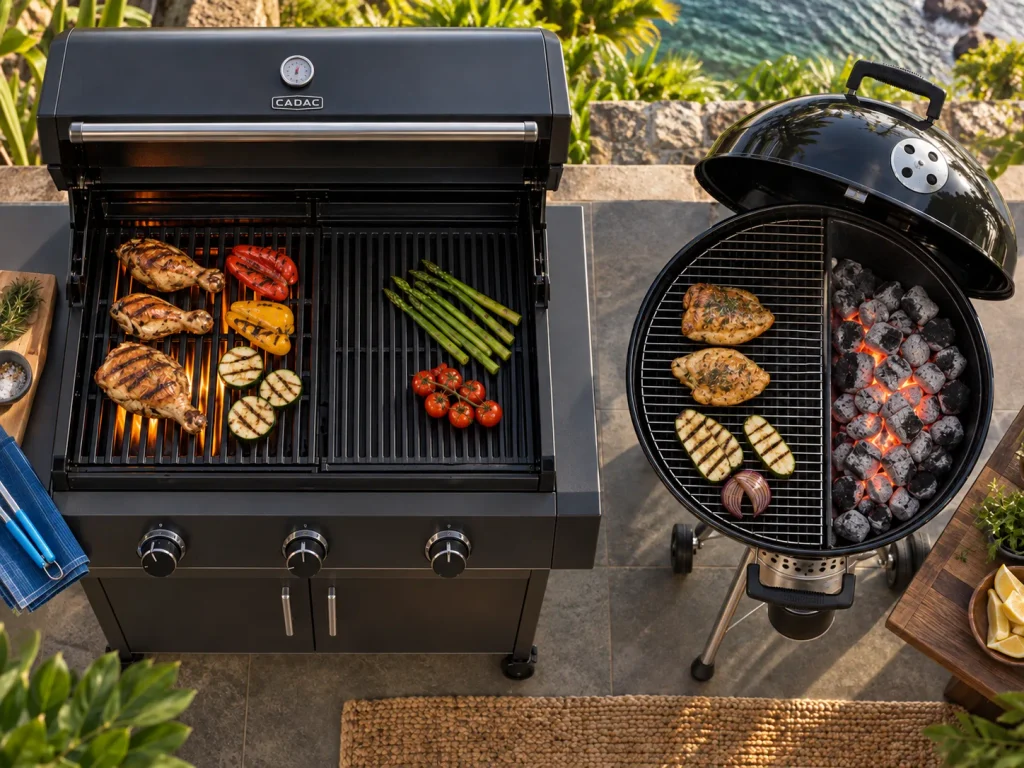
Gas offers a convenient way to adjust heat, but turning a control does not instantly cool a hot cooking surface. Charcoal is also controllable: adjustable vents regulate airflow, while the coal arrangement and the food’s position change how intensely it cooks. Both require attention.
The useful question is whether the barbecue gives you room for direct and indirect cooking:
Direct heat: food sits above the heat source. It suits searing and many shorter cooks.
Indirect heat: food sits away from the active heat source, usually with the lid closed. It helps larger pieces cook through without keeping their exterior over intense heat.
On a suitable multi-burner gas grill, you can create an indirect area by leaving a burner unlit. On a charcoal kettle, arranging coals to one side can provide a hotter area and an area without coals directly underneath. Follow your model’s instructions for the setup.
For chicken pieces with different thicknesses, that flexibility is more useful than simply chasing the highest temperature. Look at the space left for food after creating the zones, not only the total grate size.
A lid thermometer measures the cooking environment, not the centre of the food. Use a food thermometer to check safe internal temperatures.
Is gas or charcoal cheaper in Mauritius?
There are two separate questions: what the barbecue costs to buy, and what it costs each time you use it.
Compare complete setups
A simple charcoal barbecue can have a lower purchase price than a larger gas model, but fuel type alone does not determine value. Compare equipment that can cook the same sort of meal for your household.
For gas, check whether the quoted price includes the required hose and regulator, and budget for the compatible cylinder or cartridge system. For charcoal, include the fuel and suitable lighting equipment. A cover, thermometer and appropriate cleaning tools may be useful for either option.
Our BBQ accessories guide explains which additions are worth buying first.
Estimate the fuel cost for your own meals
Comparing the price of one charcoal bag with one gas refill is misleading: they will not necessarily provide the same number of meals.
A more useful calculation is:
Gas cost per cook = refill price per kilogram of gas × kilograms used for the session.
Charcoal cost per cook = bag price per kilogram × kilograms consumed for the session.
Use current local prices in MUR, include lighting consumables where relevant, and compare similar meals. For gas, count preheating as well as cooking; do not assume a manufacturer’s maximum consumption figure represents every session.
Then consider how often you cook. A small difference per meal matters more to a household grilling several times a week than to someone using the BBQ occasionally. There is no reliable universal saving to quote without knowing the equipment, local fuel prices and usage.
Which BBQ is easier to clean and maintain?
Gas avoids ash disposal, but it is not maintenance-free. Cooking surfaces, grease collection areas and accessible components still need care according to the manual.
Charcoal adds the job of removing ash once everything is fully extinguished and cold. Look for practical access to the ash collector rather than assuming all charcoal barbecues are equally difficult to clean.
For either fuel, the cooking surface affects your routine. A ceramic-coated plate needs different treatment from bare cast iron. Do not apply the same abrasive tools or cleaning method to every surface.
Before buying, ask to see how the grease tray or ash collector comes out. For a fuller routine, read our BBQ cleaning and maintenance guide for Mauritius.
What changes when you barbecue in Mauritius
Plan for storage as well as cooking
In a humid setting, especially near the coast, a protected storage position and regular care matter whichever fuel you choose. Let the BBQ cool, clean and dry it as instructed, and choose a suitable cover. A cover does not remove the need to check for trapped moisture. CADAC’s cover guidance specifically warns about moisture during prolonged storage.
Keep unused charcoal dry and sealed away from humidity; damp briquettes are harder to ignite efficiently. For gas, confirm that the supply, regulator and connections match the exact appliance sold locally. Do not assume a connection shown in an overseas buying guide is suitable for your BBQ.
Check the actual outdoor position
Measure the barbecue with its lid open and allow the clearances required by its manufacturer. Check where people will walk, where the fuel will sit and how you will keep children away from the hot equipment.
Use outdoor barbecues outdoors only. A garage, enclosed veranda or tent is not an alternative when it rains. Burning fuel can produce carbon monoxide, and charcoal remains a carbon monoxide hazard even when there are no visible flames.
For a balcony or shared property, check the building’s rules and the model’s installation instructions before buying. A compact barbecue is not automatically suitable for every small space.
Check availability before planning an event
Compare the current local range and confirm the full setup before committing to a particular model. Charcoal models shown as order on demand require confirmation of availability and lead time; a listing is not a promise of immediate collection. Browse charcoal barbecues at CADAC Mauritius.
Which should you choose for your household?
Imagine two households cooking the same chicken skewers and vegetables.
The first wants to make dinner outside after work, then clean up and move on with the evening. Gas is likely to suit that routine: there is no charcoal fire to establish, and heat adjustment is straightforward.
The second has set aside a weekend afternoon and enjoys preparing the coals and tending the fire. Charcoal fits the occasion, even if the menu is identical. These are illustrative situations, not a rule that gas is only for weekdays or charcoal only for weekends.
Choose gas if a shorter setup and convenient heat adjustment are what will make you use the BBQ regularly. Start with the gas BBQ range in Mauritius, then compare cooking area, surface type and cleaning access.
Choose charcoal if cooking over embers is a priority and you are comfortable allowing time for lighting, fire management and safe cooling. Compare the charcoal BBQ range and confirm the availability of your preferred model.
If you are still undecided, list the meals you expect to cook most often and the time you want to spend preparing them. Use those examples when comparing models. The right fuel is the one whose routine you are happy to repeat.
Before you buy
Check the permitted outdoor location and the manufacturer’s clearances.
Compare enough usable cooking space for your usual meal, including any
indirect zone you need.
Confirm the complete purchase price, fuel setup and ongoing supply.
Check how the cooking surface, grease tray or ash collector is cleaned.
Confirm stock or order lead time, the applicable warranty and access to
suitable spare parts.
Avoid three common mistakes: choosing from fuel
stereotypes alone, comparing incomplete purchase prices, and treating
storage or cleaning as something to figure out afterwards.
Frequently asked questions
Can you get a smoky flavour on a gas BBQ?
Yes, on a suitable model. A manufacturer-approved smoker box or smoking accessory can add wood smoke while gas provides the heat. The result depends on the food, cooking time and setup. Check that the method is permitted for your specific barbecue; do not assume every CADAC cooking surface supports the same smoking accessories.
Can you put charcoal in a gas BBQ?
Do not add charcoal to a gas-only barbecue unless its manufacturer explicitly permits a particular conversion or accessory. Some equipment is designed for both fuels, but that does not make an ordinary gas BBQ interchangeable with a charcoal grill. Check the exact model’s manual before buying any accessory advertised as a conversion.
Is gas grilling healthier than charcoal grilling?
Fuel alone does not settle this question. High-temperature cooking and smoke exposure can produce unwanted compounds in meat with either setup. Avoid prolonged exposure to intense heat or open flames and remove blackened portions. This does not mean undercooking food: use a thermometer to check safe internal temperatures.
How long does a gas cylinder last on a BBQ?
It depends on the amount of gas in the cylinder and the barbecue’s consumption. The number of burners in use, their settings and the duration of preheating all affect the result. Use the consumption information for the exact model as a starting point; a runtime quoted for a small portable BBQ should not be applied to a larger patio grill.
Is charcoal difficult for a beginner?
Charcoal involves learning how the fire responds to airflow and fuel arrangement. Start with a simple meal, follow the lighting instructions and create a suitable area away from the strongest heat. Gas reduces that learning curve, but a beginner who enjoys the process can still choose charcoal and build confidence with practice.
Is a portable BBQ a third option alongside gas and charcoal?
Portable describes the format, not the fuel. A portable barbecue may use gas or charcoal. Compare how much equipment you must carry, the approved fuel connection or lighting method, the cooking area and the cooling time before packing away. Choosing a smaller unit does not remove the need for a safe, permitted outdoor location.
Final Thoughts
There is no single winner in the gas vs charcoal BBQ debate. The right choice depends on how often you cook, how much time you want to spend managing the heat and the kind of outdoor cooking experience you enjoy.
A gas BBQ is generally the most convenient option for regular meals and quick heat adjustments. A charcoal BBQ is better suited to cooks who enjoy tending a fire and building flavour through fuel placement and cooking technique.
Whichever option you choose, consider the complete setup: cooking space, fuel availability, cleaning, storage and access to spare parts. The best BBQ for your home in Mauritius is ultimately the one you will enjoy using again and again.