Official CADAC Mauritius Website

What Size Generator Do I Need for My Home in Mauritius?

A practical guide to running watts, starting watts and safe home backup power
Reading time: 12-14 minutes
Quick Answer
To size a home generator, add the running watts of every appliance you plan to use at the same time, then add the largest extra starting requirement among motor-driven appliances. Keep continuous use below the generator’s verified rated output and confirm that its surge rating covers the calculated starting demand.
At a Glance
- Choose the appliances you genuinely need during an outage before choosing a generator.
- Use continuous or running watts for the normal load and starting watts for short motor surges.
- Base the decision on the generator’s rated continuous output, not only the largest wattage printed in its name.
- A 3.2 kW-class generator may cover a planned group of essentials when loads are managed; an 8 kW-class unit can support a broader set of appliances, subject to its verified ratings.
- Air conditioners, pumps, kettles, ovens and water heaters can change the calculation quickly.
- A generator must operate outdoors and must never be connected to household wiring without a safe changeover arrangement installed by a qualified electrician.
Start With the Appliances You Need
A power cut does not automatically mean that every appliance in the house must run as usual. Most households need a smaller group of priorities: refrigeration, a few lights, fans, internet access, phone charging and perhaps a water pump. A home office may also need a laptop and router. Other households may want to add an air conditioner or more kitchen equipment.
These choices determine the generator size. The floor area of the house, the number of bedrooms and the purchase price of the generator do not tell you the electrical load. Two similar homes can have very different requirements because one family plans to power only essential appliances while another expects to run cooling, pumping and cooking equipment together.
Before comparing products, write down what must work during an outage, what would be useful but optional, and what can remain off. This simple separation prevents both undersizing and unnecessary overspending.
The Common Sizing Mistake
The most common mistake is to add the wattage of several appliances and stop there. That calculation misses the brief surge created when a motor starts. Refrigerators, freezers, water pumps and many air conditioners can need considerably more power for a few seconds than they use once running.
The opposite mistake is to add every appliance’s full starting wattage at once. Motors do not normally start at the same instant. A practical calculation therefore combines the running load of everything that may operate together with the largest additional starting surge in the group. If your use case could start several motors simultaneously, or if the equipment is unusually sensitive, a qualified electrician or generator supplier should complete a more detailed assessment.
Running Watts and Starting Watts
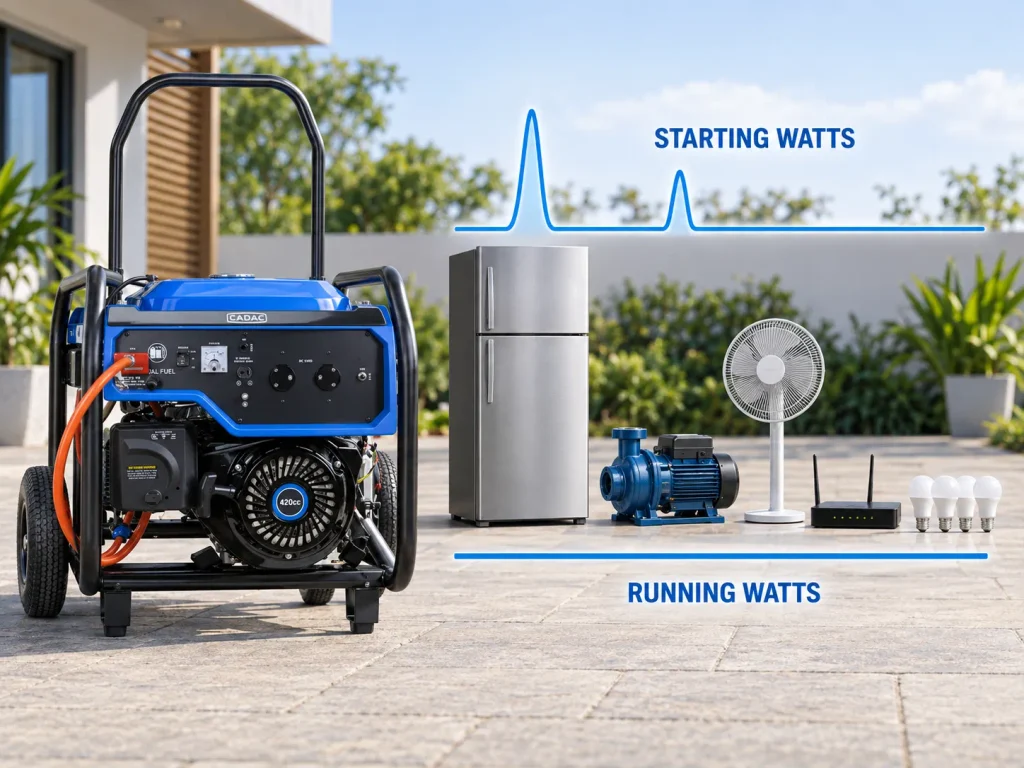
Running watts, also called rated or continuous watts, describe the power an appliance needs while operating normally. Starting watts, sometimes called surge or peak watts, describe the higher demand that some appliances create briefly when they start.
Generator product names sometimes highlight the largest wattage figure. Always check the specification plate or owner’s manual to determine whether that number is the continuous rating or the maximum rating. The distinction can materially change what the generator can power safely.
How to Calculate Generator Size
- List every appliance you may need at the same time. Separate essential loads from optional loads.
- Record the running watts from each appliance’s nameplate or manual. If a label gives volts and amps but not watts, ask a qualified person to confirm the load, especially for motors and equipment with a power factor below 1.
- Record the starting watts for refrigerators, freezers, pumps, air conditioners and other motor-driven appliances.
- Add all running watts. This is your expected continuous load.
- For each motor, subtract running watts from starting watts. Add the single largest extra starting requirement to the total running load.
- Choose a generator whose verified continuous rating comfortably exceeds the continuous load and whose surge rating exceeds the calculated starting demand.
A useful operating target is to avoid running a portable generator continuously at its absolute limit. Queensland’s Electrical Safety Office advises that a generator should not run continuously above 80% of its rated capacity. This provides a planning margin for small load changes and reduces the chance of persistent overloading.
The Calculation in One Line
Required starting capacity = total running watts + the largest additional starting requirement
Continuous-load check = total running watts divided by 0.8
The selected generator should satisfy both checks. Use the manufacturer’s verified continuous and surge ratings, not an assumed rating based only on the model name.
Worked Example for Essential Home Loads
The following example shows the method. Apart from the refrigerator figure cited by the Electrical Safety Office, the numbers are illustrative nameplate values. Replace every value with the figures from your own appliances before choosing a generator.
The continuous load is 540 W. Dividing by 0.8 gives a continuous-capacity planning target of 675 W. The starting requirement is 540 W plus the refrigerator’s additional 1,620 W, for a total of 2,160 W. The chosen generator therefore needs a verified continuous rating above the planned running load and a verified surge rating above 2,160 W. The calculation does not yet include a pump, air conditioner, microwave, kettle or other high-draw appliance.
This example also shows why a refrigerator cannot be represented by its running wattage alone. A generator that appears large enough for 540 W of steady demand may still fail when the compressor starts if its short-term surge capacity is too low.
What kW and kVA Mean
Generator capacity may be shown in kilowatts or kilovolt-amperes. Kilowatts represent real power used to perform work. Kilovolt-amperes represent apparent power, which also reflects the power factor of the connected load. For a purely resistive appliance with a power factor of 1, the numerical values can be similar. Motors and electronic equipment may have a lower or changing power factor.
If a generator is rated only in kVA, do not automatically treat 1 kVA as 1 kW for a mixed household load. Use the manufacturer’s rated power factor or ask the supplier or a qualified electrician to confirm the available real power. The same caution applies when an appliance label gives volts and amps but no wattage. A simple volts-times-amps calculation can overstate or understate real power when power factor and motor starting behaviour are not considered.
Appliance Planning Table
The values below are planning examples, not substitutes for appliance labels. Actual wattage varies by model, efficiency, age and operating mode. The Electrical Safety Office gives approximately 180 running watts and 1,800 starting watts for a refrigerator or freezer, illustrating how large the starting difference can be.
Three Home Backup Scenarios
Scenario 1 Essential Appliances
A household wants to run one refrigerator, several LED lights, two fans, a router, one television and a laptop. Using the refrigerator example above and the actual labels for the remaining items, the continuous load may be modest, but the refrigerator’s starting surge can dominate the calculation.
This type of carefully managed essentials-only plan may fit within a 3.2 kW-class generator. The decision still depends on the product’s verified continuous and surge ratings. The household should avoid adding a kettle, microwave, pump or air conditioner without recalculating the load.
Scenario 2 Essentials Plus a Water Pump
Adding a water pump changes the picture because the pump motor can create a significant starting demand. If the refrigerator and pump are allowed to restart together, their combined behaviour may exceed a smaller generator’s surge capacity even when their normal running watts appear acceptable.
Load management can help. The user may start the pump first, allow it to stabilise, and then reconnect other appliances in stages. However, this should only be done within the generator and appliance manufacturers’ instructions. If the pump is critical or automatically controlled, size the system for realistic simultaneous operation rather than assuming perfect manual timing.
Scenario 3 Broader Backup With Cooling or Cooking
An air conditioner, electric kettle, microwave, hotplate or electric water heater can use a large share of a portable generator’s capacity. Running several of these loads with refrigeration, lights and a pump can push demand well beyond an essentials-only setup.
An 8 kW-class generator provides more flexibility, but the name alone does not guarantee whole-home power. Check the unit’s continuous rating, surge rating, outlet limits, voltage, frequency and fuel-specific output. A qualified electrician should assess any connection to fixed household circuits and identify which circuits can operate together.
Use Load Management to Avoid Unnecessary Capacity
A generator does not need to power every optional appliance at the same time. Load management means deciding which loads can be delayed, switched off or used in sequence. This can reduce the required generator size without sacrificing the appliances that matter most.
For example, a household may keep the refrigerator, lights and router connected continuously, run the water pump only when needed and leave the kettle or microwave off while the pump is operating. Large motor loads should be started one at a time, with enough time for each appliance to stabilise before another major load is added.
This approach works only when users understand the plan and the equipment permits manual control. It is less suitable for critical automatic loads that may restart without warning. Write the operating sequence beside the generator and make sure every adult who may use it understands the continuous limit, the surge limit and the circuits or appliances that must remain off.
Load management also helps prevent nuisance trips. If the generator’s breaker trips, do not repeatedly reset it without reducing the load and identifying the cause. Persistent overloading can damage the generator or connected equipment.
Choosing Between a 3.2 kW and 8 kW Generator
CADAC Mauritius currently lists an LPG Generator 3200W, a Petrol and LPG Dual Generator 3200W and a Petrol and LPG Dual Generator 8000W. Product availability and specifications can change, so compare the current product page with the manual and nameplate before deciding.
Explore: compare CADAC generators available in Mauritius
Petrol LPG and Dual Fuel Options
Fuel choice affects convenience, storage and how you plan for an outage. A petrol generator uses a widely understood fuel system, while an LPG model can suit households that already manage approved LPG storage and connections. A dual-fuel generator gives the user a choice between petrol and LPG, which can improve flexibility when one fuel is less convenient to obtain.
Do not assume that a generator produces identical power on every fuel. Some dual-fuel models have different output ratings depending on the fuel used. Confirm the CADAC manual or nameplate for the specific model. Use only the specified regulator, hose, cylinder and fuel connection. A barbecue regulator or improvised fitting should never be used unless the generator manufacturer explicitly approves it.
Fuel must be stored and handled according to the generator manual and local requirements. Shut the generator down and allow it to cool before refuelling. Keep fuel away from ignition sources, living areas and children.
What Changes in Mauritius
Mauritius’ Electricity Safety Quality and Continuity Regulations declare a low-voltage supply of 230 volts between phase and neutral and a frequency of 50 hertz. A generator intended for household appliances must therefore provide compatible voltage and frequency, and the plugs, protective devices and connection method must match the equipment being powered.
Humidity, rainfall and coastal air also affect operation and storage. A generator needs outdoor ventilation, but it must not be exposed to unsafe wet conditions. Follow the manufacturer’s wet-weather instructions and use only a purpose-designed, non-combustible generator cover or tent if the manufacturer permits one. A domestic veranda, garage, shed or carport is not a safe substitute for the required outdoor separation from occupied buildings.
After use, allow the generator to cool, store it in a dry location and inspect metal parts, leads, plugs and fuel connections regularly. Coastal corrosion and damaged insulation can turn a reliable backup tool into an electrical or fire hazard.
Safe Placement and Connection
Portable generators produce carbon monoxide, a colourless and odourless gas that can be fatal. The US Consumer Product Safety Commission advises operating a portable generator outdoors only, at least 20 feet, or about 6 metres, from the home, with the exhaust directed away from the building. Keep it away from doors, windows, vents and any nearby occupied structure.
- Never operate a portable generator inside a home, garage, basement, shed, enclosed veranda or other enclosed or partly enclosed space.
- Do not rely on an open door, open window or household fan to remove carbon monoxide.
- Install and maintain carbon-monoxide alarms in the home according to the alarm manufacturer’s instructions.
- Keep the generator dry and follow its wet-weather instructions. Never handle plugs or leads with wet hands.
- Plug appliances directly into the generator or use a heavy-duty outdoor-rated extension lead that is correctly rated for the total load and length.
- Never connect a generator to a household wall socket. This practice, often called backfeeding, can energise wiring unexpectedly and endanger occupants, electricians and utility workers.
- If the generator will supply fixed household circuits, use a suitable changeover or transfer arrangement installed by a qualified electrician.
- Turn the generator off and allow it to cool before adding petrol or performing maintenance.
Prepare Before the Power Goes Out
A generator is most useful when the household has already tested the plan. Before an outage, label the approved extension leads, identify the appliances that may be connected and keep the operating sequence with the manual. Test carbon-monoxide alarms and confirm that the outdoor location remains available in heavy rain or strong wind without moving the generator closer to the building.
Follow the maintenance schedule in the generator manual. Check engine oil, fuel condition, battery condition where applicable, air filters, spark plugs, leads and visible fuel connections. Run tests only under safe outdoor conditions and with a planned load. A generator that has been stored for months should not be assumed ready simply because it started the last time it was used.
If the unit uses LPG, inspect the approved hose, regulator and cylinder connection. If it uses petrol, follow the manufacturer’s fuel-storage and stabilisation guidance. Never keep fuel in an unapproved container or refill a hot generator. Record service dates so that the generator remains an emergency resource rather than an untested appliance.
Common Mistakes to Avoid
Choosing from the largest number on the box. A maximum or surge figure is not the same as continuous output. Compare the verified rated output with your running load.
Sizing from the house rather than the load. Bedrooms and square metres do not reveal which appliances will operate together. Build an appliance list.
Ignoring motor starts. A refrigerator, freezer, pump or air conditioner can exceed its normal running demand briefly. Include the largest additional surge.
Treating an 8 kW-class portable generator as automatic whole-home backup. Whole-home supply depends on the verified output, circuit design, major appliances and safe connection method.
Using improvised plugs or fuel fittings. Electrical backfeeding and unsuitable LPG fittings can create severe risks. Use approved equipment and qualified installation.
Placing the generator close to the house because of rain. Wet-weather protection must not trap exhaust or move the generator into a garage, carport or veranda.
Quick Decision Guide
Before You Buy
- Write down the exact appliances that must run during an outage.
- Record running watts and starting watts from labels or manuals.
- Calculate the continuous load and largest additional starting surge.
- Confirm the generator’s continuous output and peak output separately.
- Confirm whether output changes between petrol and LPG.
- Check 230 V and 50 Hz compatibility, outlet type and circuit-breaker limits.
- Decide whether appliances will plug in directly or fixed circuits will use a professionally installed changeover system.
- Plan a dry outdoor operating position at least about 6 metres from occupied buildings, with the exhaust directed away.
- Choose correctly rated outdoor leads and carbon-monoxide alarms.
- Check current stock, warranty, maintenance requirements and access to service or spare parts.
The CADAC Perspective
A useful generator recommendation begins with the customer’s load list, not with a product name. Two customers can buy the same generator and have very different experiences because one manages a small group of essential appliances while the other adds pumps, cooling and electric cooking without recalculating.
When comparing CADAC’s 3.2 kW and 8 kW generator options, bring the wattage labels or manuals for the appliances that matter most. CADAC Mauritius can then help you compare the available generator specifications, while a qualified electrician should advise on fixed wiring, changeover equipment and installation.
Choose the Load Before the Generator
The right generator is the one that safely covers the appliances you have chosen to protect. Start with an essentials list, calculate the continuous load, include the largest starting surge and verify the generator’s rated and peak outputs. This method gives you a more reliable answer than choosing by house size or assuming that every appliance can run together.
Next step: compare CADAC generators available in Mauritius or contact CADAC Mauritius with your appliance list before purchasing.
Frequently Asked Questions
How do I calculate what size generator I need?
Add the running watts of every appliance you expect to use at the same time. Then add the largest additional starting requirement, calculated as starting watts minus running watts for the motor with the biggest surge. Check that the generator’s continuous rating covers the running load and its peak rating covers the starting demand.
Is a 3.2 kW generator enough for a house?
It can be enough for a planned group of essential appliances, such as refrigeration, lights, fans, Wi-Fi and charging, when their actual loads fit within the verified ratings. It is not automatically enough for a pump, air conditioner, kettle, microwave or several high-draw appliances operating together.
What can an 8,000 W generator power?
An 8 kW-class generator can support more simultaneous loads than a 3.2 kW-class unit, but the answer depends on its continuous output, surge output and fuel-specific rating. It should not be described as whole-home backup until the household circuits and major appliances have been assessed.
Can a generator run an air conditioner?
Possibly, but air conditioners vary widely. Check the unit’s rated input, maximum input and starting current. Inverter air conditioners may start differently from fixed-speed models. A qualified electrician or supplier should confirm compatibility before you include air conditioning in the backup plan.
Do I add the starting watts of every appliance?
Usually, you add all running watts and the single largest additional starting surge because motors do not normally start together. If two or more automatic appliances could restart at the same time, or if the load is critical, use a more conservative calculation completed by a qualified professional.
Can I plug a generator into a household wall socket?
No. Connecting a portable generator through a wall socket can backfeed the household wiring and the electricity network. Plug approved appliances directly into the generator using correctly rated equipment, or have a qualified electrician install a compliant changeover or transfer arrangement.
How far should a portable generator be from the house?
The US Consumer Product Safety Commission advises using portable generators outdoors only, at least 20 feet, or approximately 6 metres, from the home. Point the exhaust away from buildings and keep the generator away from windows, doors and vents.
Is LPG or petrol better for home backup?
The better fuel depends on the model, the manufacturer’s approved connections and how you can store and obtain fuel safely. Dual-fuel generators provide flexibility, but their power output may differ by fuel. Compare the fuel-specific ratings and follow the exact regulator, hose and storage instructions in the manual.
What is the difference between kW and kVA?
Kilowatts measure real power used by equipment. Kilovolt-amperes measure apparent power and also depend on power factor. Do not assume that 1 kVA always equals 1 kW for a mixed household load. If a generator or appliance is rated only in kVA, ask the supplier or an electrician to convert it correctly.
Final Thoughts
The right generator is not necessarily the largest one. It is the model that can safely support the appliances you genuinely need during a power cut. List your essential equipment, calculate the combined running load, include the largest starting surge and compare the result with the generator’s verified continuous and peak output.
This approach will help you choose between a more compact 3.2 kW option and a higher-capacity 8 kW generator without undersizing your system or paying for capacity you do not need.